Distribution-transformer efficiency, manufacturing capacity and material availability are again under review in the United States. In June 2026, the U.S. Department of Energy issued a request for information on how energy-conservation standards for distribution transformers affect national security, domestic manufacturing, supply-chain resilience and the cost and availability of key materials.
What the DOE Is Reviewing
The current U.S. efficiency standards were finalised in April 2024 and are scheduled to take effect in 2029. The 2026 review asks how the transition may interact with manufacturing investment, production capacity, transformer availability and electrical-core-steel supply. It follows a federal determination that grid-infrastructure supply chains, including distribution transformers and core steel, are essential to national defence.
The review does not by itself change a project specification. It does show that efficiency requirements and supply capacity are being considered together. For utilities, contractors and equipment buyers, both factors can affect procurement decisions made well before the equipment is delivered.
Why the Issue Matters Internationally
Transformer supply chains cross national borders. Core steel, copper or aluminium conductors, insulation systems, bushings, tap changers and monitoring accessories may come from different suppliers and markets. A change in demand or compliance requirements in one major market can influence material allocation and factory planning elsewhere.
At the same time, a transformer designed for one market is not automatically suitable for another. Buyers still need to identify the applicable IEC, IEEE/ANSI, DOE or local requirements, as well as project-specific loss limits and test documentation.
Five Items Buyers Should Confirm
Destination-market requirements: identify the efficiency rule, test method, certification and labelling requirements that apply at the installation location.
Guaranteed losses: state no-load loss, load loss, reference temperature and any evaluation method in the purchase specification.
Características elétricas: confirm capacity, voltage ratio, frequency, vector group, impedance, tapping range and expected load profile.
Materials and construction: agree the core material, winding conductor, insulation system, fluid or dry-type construction, cooling method and enclosure.
Production and approval schedule: allow time for drawings, technical clarification, material procurement, routine tests, optional type or special tests and shipping.
Prepare Specifications Before Capacity Is Reserved
Early procurement does not mean ordering before the design is ready. It means resolving the parameters that control transformer design and material selection early enough for suppliers to provide a reliable offer and production plan. Standardising voltage classes, accessories and documentation across similar projects can also reduce engineering cycles where site conditions allow.
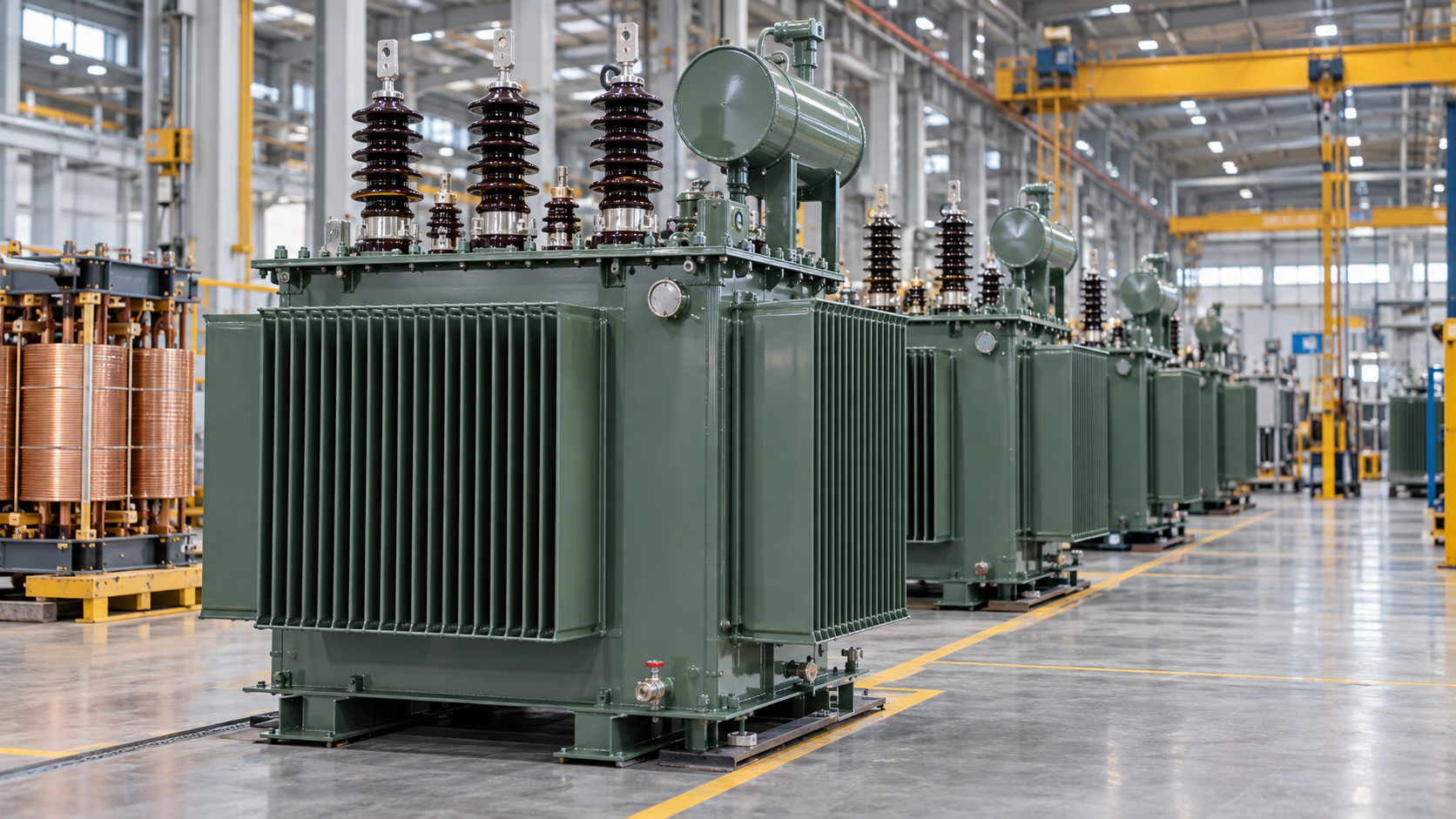
Whether a project uses an oil-immersed, dry-type, pad-mounted or pole-mounted transformer, efficiency should be evaluated together with loading, environment, maintainability, safety and applicable standards. A complete data sheet remains the best starting point for comparing technically equivalent proposals.
Fast-charging networks are increasing both the number and the power rating of public charging points. The International Energy Agency’s Global EV Outlook 2026 reports that fast and ultra-fast chargers grew from 1.5 million in 2024 to 2.2 million i...
Grid connection queues are becoming a central issue for power-system developers. The International Energy Agency’s Electricity 2026 report says more than 2,500 GW of renewable generation, storage and large-load projects are waiting in connection q...
A procura global de eletricidade está a acelerar no período de 2026–2027. Descubra por que razão a eficiência dos transformadores, a capacidade da rede, a definição antecipada das especificações e o planeamento coordenado dos quadros elétricos são importantes para novos projetos de energia.
Utility-scale battery storage is expanding rapidly. The U.S. Energy Information Administration reported in August 2026 that operational battery storage capacity reached nearly 52 GW in the first half of the year after averaging 70% annual growth o...
 Categorias em destaque











Enviar um pedido de informação sobre o produto
Entraremos em contacto consigo no prazo de 24 horas