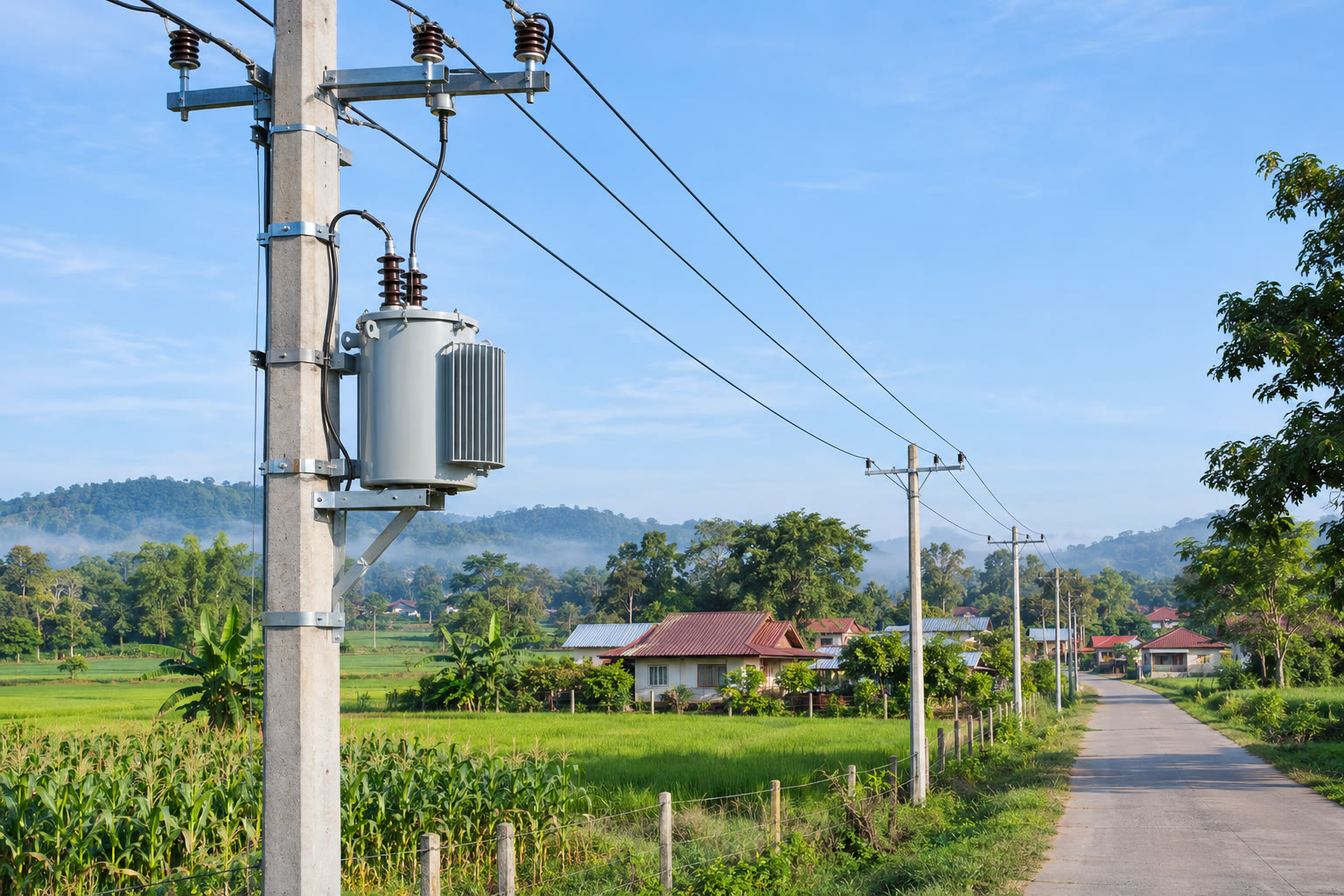
Underground distribution is growing in cities and new developments, but pole-mounted transformers remain an efficient solution for many rural and low-density networks. They use the existing overhead route, require little ground space and can be installed close to dispersed loads.
Rural design still requires careful engineering. Long feeders, lightning exposure, seasonal demand and limited maintenance access influence voltage regulation, protection and the number of transformer points along the line.
Plan Around Load Density and Feeder Length
A few large transformers may simplify inventory, but long low-voltage circuits increase voltage drop and conductor losses. More frequent smaller units can shorten secondary runs and improve voltage at remote customers.
The design should consider current demand, productive-use growth, irrigation or agricultural motors, community services and future connections. Load diversity is helpful, but motor starting and evening peaks can still govern voltage performance.
Protection and Environmental Checks
Coordinate primary fuses with transformer inrush, downstream faults and upstream recloser operation.
Select surge arresters and grounding for the local lightning exposure and soil conditions.
Confirm pole strength, transformer mass, conductor tension and approved mounting hardware.
Specify insulation level and clearances for altitude, pollution and wildlife exposure.
Provide safe switching, isolation and lifting access for trained utility crews.
Standardize ratings and accessories where possible to simplify rural spare inventory.
Design for Inspection and Replacement
Road condition and seasonal access can dominate outage duration in remote areas. Utilities should map access routes, lifting requirements and spare locations before a failure occurs.
Routine patrols can identify damaged arresters, leaking tanks, loose hardware, vegetation conflicts and overheated connections. A simple inspection program protects both transformer life and feeder reliability.
Compare os transformadores montados em plataforma e os montados em poste em termos de instalação, segurança, capacidade, manutenção e aplicação, para escolher a solução de distribuição mais adequada.
O inversor fotovoltaico, enquanto componente importante da produção de energia fotovoltaica, tem como principal função converter a corrente contínua emitida pelos módulos fotovoltaicos em corrente alternada. O inversor não só tem a função de conversão direta para corrente alternada, mas...
Crushers, mills, conveyors, pumps and fans make mining and cement plants demanding electrical environments. Large motors create starting and cyclic loads, while dust, high ambient temperature and limited shutdown windows challenge transformer cool...
Enquanto equipamento comum de gestão da distribuição de energia, o disjuntor é indispensável em quase todas as áreas de consumo de energia. À medida que a cidade continua a modernizar-se, os disjuntores são constantemente atualizados. Com o surgimento da Internet das Coisas...
 Categorias em destaque













Enviar um pedido de informação sobre o produto
Entraremos em contacto consigo no prazo de 24 horas